
August Water News

Visit to B & W Quality Growers, LLC - Fellsmere, FL
Marcel Barbier, PhD, Director of Research and CWC Board Member
B & W Quality Growers has transformed what was a costly waste disposal problem into a sustainable nutrient recycling program that demonstrates how agriculture can become part of the solution for improving water quality.
Prior to implementing the composting program, discarded leafy vegetables (including arugula, spinach, kale and watercress) were transported to landfills. The accumulation of decomposing organic material generated unpleasant odors and attracted fly populations around the packing facility.
Today, instead of becoming waste, these materials are transformed into a valuable agricultural resource. B & W Quality Growers currently composts approximately 30 tons of leafy vegetable residues every week using a controlled windrow composting system. The compost records demonstrate thermophilic temperatures ranging from 115-137 degrees during active composting, followed by successive turning, screening prior to delivery back to production fields.
The process supports:
Improved soil organic matter
Increased biological activity
Better nutrient recycling
Reduced dependence on imported fertilizers by 20% while improving soil health
Composting transforms nutrients from a pollution liability into a resource, offering a practical pathway toward healthier soils, cleaner waterways and a more sustainable environment.
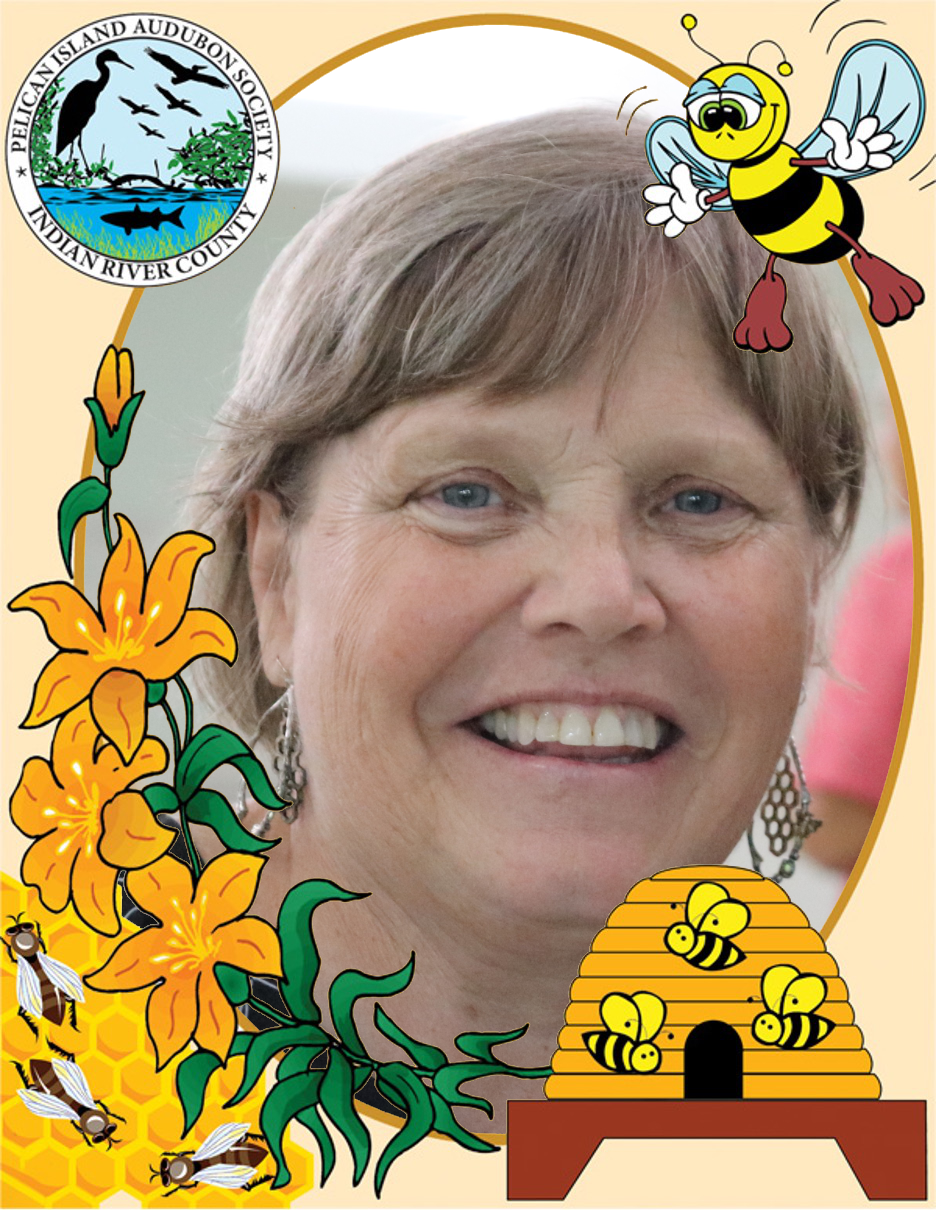
Donna Halleran Retires as Executive Director of Pelican Island Audubon Society (PIAS)
A party was held at the Garden Club of Indian River County to celebrate Donna and all that she has accomplished as the Executive Director of Pelican Island Audubon Society. The room was filled with friends from the various organizations that Donna supports with her knowledge, enthusiasm and never-ending energy.
Donna is always willing to step up when there is a need. When we needed to get all of the environmental organizations working together with a stronger environmental voice – Donna organized a meeting and the Clean Water Coalition was born.
When there was a need to get a group of children organized to be a voice for the environment – River Kidz was formed under Donna’s leadership. And then the Audubon Advocates program which serves the neediest kids, including the homeless, in quality afterschool activities.
Donna brought in significant funding to PIAS via her excellent grant writing skills. Part of the success is because she actively participates with so many partner organizations.
The Clean Water Coalition is grateful to have Donna volunteer as our parliamentarian.
Should you wish to honor Donna’s Audubon service, there is an education scholarship fund accepting donations at https://pelicanislandaudubon.org/

FAA moves to waive environmental review for rocket launches
On July 30 the FAA proposed a rule that would let it set aside most environmental and historic preservation requirements when it licenses commercial space activity, including the National Environmental Policy Act, the Clean Water Act, and the Endangered Species Act. That matters for our lagoon system: the launch corridor sits alongside Canaveral National Seashore and the Merritt Island National Wildlife Refuge, where biologists have counted more than 310 bird species along with sea turtles and a dozen-plus other endangered species. Launch traffic is climbing fast (109 rockets from the Space Coast last year, a regional record, with SpaceX having previously proposed as many as 76 Starship launches a year in Brevard).
The water quality concerns are close to home. Vero Beach fish ecologist Grant Gilmore, who recorded underwater sound from decades of launches during seatrout and drum spawning season, described the noise as comparable to a major earthquake and told Florida Today his bigger worry is pollution in the poorly flushed northern reaches of the Indian River, Banana River, and Mosquito Lagoon. Researchers who studied vegetation changes near the pads reached a similar conclusion (nobody has really measured what the cumulative effect of this launch cadence will be). Comments on the proposal are open through the Federal Register.

Three More Derelict Boats Are Out of the Lagoon
Indian River County has pulled three derelict vessels from the Indian River Lagoon since January, and FWC has just cleared three more for removal. That's from an update Lagoon Resources Manager Melissa Meisenburg sent to the County Commission for its August 4 meeting.
Under state law, a derelict vessel is one left or abandoned in a wrecked, junked, or substantially dismantled condition on state waters. They're navigation hazards, and the county's Lagoon Management Plan flags what they do to the lagoon itself: damage to benthic habitat, scattered debris, and contaminants leaching out as the boats break apart. Removal isn't quick, either. Each vessel goes through an investigation to find its owner before FWC can approve taking it out.
The three removed so far were a 41' Albin, a 37' Endeavor, and a 34' Hunter, all sailboats. Total cost was $20,122, with $13,922 covered by FWC's Bulk Derelict Vessel Grant. The Hunter came out under emergency action, which made it ineligible for reimbursement, so the county ate that $6,200.
Three more are in grant processing now, plus one already-investigated vessel FWC expects to remove itself. Staff plan to ask the Board to apply for the 2026/2027 grant round.

What is an aquifer?
An aquifer is a layer of rock or sediment underground that both holds water and lets it move. Rain falls, soaks into the ground, and works its way down through tiny pore spaces in the rock. If those pores connect to each other, water can flow through, and you have an aquifer. If they don't (clay is the classic example) the water gets held in place instead of passing through. Those tight clay layers are called confining units, and they're what separate one aquifer from another.
Florida's underlying limestone is unusually good at this. It's full of both original pore space and the cracks and channels that form as slightly acidic water dissolves the rock over time (our karst geology, the same process behind sinkholes and springs). That makes Florida's aquifers some of the most productive in the world.
Here, the Surficial Aquifer sits just below the ground surface and is recharged by local rainfall. The Floridan Aquifer sits much deeper, beneath confining layers, and underlies the entire state. It's the primary drinking water source for most of Florida.

Seagrass Restoration Work at Harbor Branch
In June, Florida Atlantic University's Harbor Branch Oceanographic Institute completed its largest seagrass restoration planting to date in the Indian River Lagoon. Over two days, the team harvested and planted five areas of shoal grass (Halodule wrightii) in roughly five feet of water at the deeper edge of an existing seagrass meadow. The seagrass had been grown in the Harbor Branch Seagrass Nursery in water pumped directly from the lagoon. By planting in a deeper area, researchers from FAU’s Seagrass Ecology and Ecosystem Science Laboratory are testing restoration strategies where seagrass had not yet been able to recover. The site will be monitored weekly for the next several months to perform maintenance and collect data.
Reprinted from FAU HBOI News

Endangered Species Act Rules Are Changing.Here's What It Means for Florida Wildlife.
Three federal rule changes landed this summer, and all three have drawn both praise and lawsuits.
On July 14, the U.S. Fish and Wildlife Service and the National Marine Fisheries Service removed the regulatory definition of "harm" from the ESA. Since 1981, that definition held that habitat modification could count as illegal "take" when it actually killed or injured wildlife. No replacement definition was issued. The change takes effect September 14.
On July 21, Fish and Wildlife published two more rules, effective August 20. One ends the "blanket rule" that automatically gave newly listed threatened species most endangered-species protections (they will now get species-specific rules that weigh economic impacts alongside conservation). The other gives more weight to economic factors when excluding areas from critical habitat.
Interior Secretary Doug Burgum says the changes restore the law's original intent and give landowners certainty. Conservation groups counter that habitat loss drives most extinctions, so narrowing "harm" guts the ESA's most useful tool. Earthjustice and a coalition of groups have sued, and four Florida members of Congress have asked the agencies to withdraw the threatened-species rules.
Locally: the panther is endangered, so the blanket-rule change doesn't touch it. Manatees are threatened, but their current protections stay unless Fish and Wildlife revises them separately. What's most at stake here is habitat, which for the Indian River Lagoon means seagrass.

Candidate Questionnaire: County Commission Responses
IRNA, Pelican Island Audubon Society, and the Clean Water Coalition sent questionnaires to every candidate running for the Board of County Commissioners. We're running the responses one more week for anyone who missed them.
Every candidate got the same questions on the same day with the same deadline, submitted through an online form. Responses are published unedited so voters hear candidates in their own words. As 501(c)(3) organizations, we don't endorse candidates (this is voter education, plain and simple).
The questions covered the property tax amendment (Amendment 3/HJR 1F) and its impact on water infrastructure funding, sustaining Lagoon restoration under funding pressure, water quality in the Indian River Lagoon and Blue Cypress Lake, long-term potable water supply and utility expansion, and city-county collaboration on annexation and growth.
Five candidates responded:
Bob McPartlan (Dist 2)
Jennifer A. Pippin (Dist 2)
Daniel Brooks Robinson (Dist 2)
Marc Jaffe (Dist 4)
Deryl Byron Loar (Dist 4)
Our thanks to all five for taking the time. Their answers help Indian River County residents get to the ballot box better informed.


Comments